Sunday, April 17, 2011

Blue Steel Triathlon Club - Bicycle Indoor Time Trials

What do New Hampshire outdoor enthusiasts do on a cold blustery day in March? We ride our bikes indoors! On Sunday March 27th in Milley’s Tavern alongside the roaring Merrimack River in Manchester, the Blue Steel Tri Club coordinated a 10K indoor course race using dynamic bicycle trainers that allows athletes to ride their own bike while pedaling a challenging course simulated with an interactive computer interface.

Sound easy? Nope!  Riding your bike up steep hills mixed with going all-out on flat raceways, has you shifting constantly to maintain your cadence and watts.

Fast Splits provided the Computrainers, computer software, hardware and peripherals (interface meters between the computer and the rider’s trainer).

This was my first simulated bicycle time trail, and I did not know what to expect. Frankly, given the cold weather of our New Hampshire spring, I had only been outside riding twice along with one indoor spinning session three days before the race.

Let’s enter the room where the race time trial takes place.  There is a computer control station centered in back of eight trainers. In front of the trainers is a 5x6 computer screen image (below) with the name of each of the eight riders, and race specific information for each rider to see their race position and effort: how far behind/ahead of the others; distance traveled; time into the race; speed; watts (calculated by rider/bike weight, velocity in mph, amongst other variables.) (http://bikecalculator.com/veloUS.html.)

We had sixty-four men and women cyclists ranging in age to 70 years young.

A race like this cannot exist with just athletes. Three behind the scene people made this event happen. Jeff Litchfield and Mike Bradford of Blue Steel Tri Club organized the event and worked throughout the day handling issues to make sure things went smoothly. Johnny from Blue Steel Cyclery, our Gold Sponsor, helped athletes set up their bikes, tweak air pressure, insert skewers, and other maintenance items as requested by the athletes.


The selected interviews in the below video go beyond asking the traditional, “How did you feel while racing?” Instead I, as a fellow competitor, wanted to hear and learn - “What parameters from the race screen were important to you during the race?” Many of the responses are humorous as they show the competitiveness of friendly rivals.

Want to see the results of the Bikes and Beers Time Trial?  To see all the day's videos and pictures click here.


Steve’s latest book, Outdoor Enthusiast: Never say, “I wish I had…” is now available both in hard copy (http://www.outdoorsteve.com/) and in e-Book (Kindle and Nook).

Tuesday, March 29, 2011

A Volunteer for Running Shoe Development

I received an email from Pedro Rodrigues, a Sports Research Engineer in the New Balance Sports Research Laboratory.  New Balance was launching a new research study looking at the effects of running shoes on lower extremity mechanics.  Pedro asked if I would be interested in serving as a tester.

Absolutely! I have been a committed runner for 25 plus years, have experienced a variety of leg and foot injuries, and have run in numerous brands of running shoes to “improve my speed” and avoid injury.  In fact, I was currently running in New Balance shoes, and my contribution to this study might provide valuable data and help develop new running shoes and technologies. Besides, I could not pass up a chance to take part in a running shoe study by an athletic shoe manufacturer making their shoes in the USA.

I drove to the research lab in Lawrence, MA, and signed confidentiality and injury release forms. Pedro explained the goal of the study was to evaluate how a single component of the running shoe affected the mechanics of my leg.  Therefore, each shoe was essentially identical other than that single factor, allowing the researchers to understand the specific effects of that one factor.  I then ran on a treadmill in ten different pairs of shoes.

Pedro measured my leg and ankle and then place reflective markers in specific anatomic locations.  These reflective markers were then tracked using a motion capture system (Qualisys, Gothenburg, Sweden) as I ran on the treadmill at a constant speed.  This system consisted of 8 cameras, which sent out infrared light that reflected off these markers.  Next, by combining the view of each camera, the motion of my leg could be reconstructed in 3-D (see video), allowing the engineers to calculate joint angles, velocities, etc.  In this particular case they were interested in the position of my ankle when I first struck the ground, the amount I pronated (foot rolling to the inside), the speed I pronate, etc.  They will collect this information on a number of runners and will run statistical analyses to see if the controlled factor had any effect on a runner’s lower body mechanics.

Share with me the excitement of running research. New Balance offered me an opportunity related to my dedication to running. Running is a major part of my lifestyle and I firmly believe running allows me the cardiac endurance and fitness to maintain my outdoor pursuits. Click on the video showing the body marking and reflectors, running on the treadmill, and the 3-D results.

Now, I never have to say, "I wish I had contributed to a New Balance running shoe study. "


Steve’s latest books, Outdoor Enthusiast: Never say, “I wish I had…” are available both in hard copy (www.outdoorsteve.com/) and in e-Book (Kindle and Nook).

Click this link to SUBSCRIBE to OutdoorSteve's YouTube Channel


"Everyone should believe in something. I believe I’ll go Outdoors.” 

Steve’s books are available as hardcopy and e-Books at Amazon's Kindle and hardcopy at Harborside Trading Company, 81 Main St, Sunapee, NHWild Goose Country Store, 77 Main St, Sunapee, NH, Morgan Hill Bookstore, New London, NH, Bookstore at Colby-Sawyer College, New London, NH, Dartmouth-Hitchcock Gift Shop, Lebanon, NH, and Village Sports, New London, NH.


For more of Steve’s outdoor guidebooks and documentary videos, visit OutdoorSteve.com and Outdooradventurers.blogspot.com.


Sunday, March 20, 2011

Outdoor Enthusiast Now Available in E-book format!

For $3.99 you can download Outdoor Enthusiast: Never say, “I wish I had…” from Kindle.com and Nook.com onto your portable e-book reader.


In addition to Amazon’s Kindle (ASIN B004S7EZLQ) and Barnes and Noble's Nook (ISBN 9780615225050), the Outdoor Enthusiast e-book can be downloaded to various e-book readers and smart cell phones:


  • Kindle for Mac
  • Kindle for PC
  • Kindle for iPad/iPhone
  • Kindle for BlackBerry
  • Kindle for Android
  • Kindle for Windows Phone
  • Nook for Android
  • Nook for iPad/iPhone
  • Nook for iPod Touch
  • Nook for Blackberry
  • Nook for PC
  • Nook for Mac

If you notice content issues when reading the book, please send me an email at steve@outdoorsteve.com.  When I update Outdoor Enthusiast, I will notify you to re-load the book.

Saturday, March 5, 2011

Winter Wild at Mt Sunapee New Hampshire

Winter in New Hampshire offers exciting opportunities for outdoor enthusiasts. This unique ski area race is called “Winter Wild“ (http://www.winterwild.com/) and was held March 5th at Mt Sunapee Ski Mountain, Newbury, NH (http://www.mountsunapee.com/).

The rules for this four mile snow-covered uphill/downhill race at Mt Sunapee were pretty easy and simple. You cannot leave anything stashed anywhere on the mountain! Whatever you go up with you must return with at the bottom the hill.

The 133 athletes wore a mixture of ski and running equipment. Some donned their alpine skies up the hill, while others backpacked them up. Others wore back country skis or Telemark skis, and either wore them climbing up the hill or backpacked them. Many skiers used climbing "skins" on the bottom of their skis for traction uphill on the icy and snowy slopes. Quite a few wore crampons with hiking boots or running shoes.

My choice was my hiking boots with running crampons.

The Mt Sunapee course is marked on the map in red and follows the clockwise peripheral of the ski area. The course begins at Spruce Lodge and then up Elliot Slope to the access road down where you ascend the Williamson Trail to Stovepipe and up to the Mount Sunapee summit. You descend the Upper Ridge to the Lower Ridge trail returning to the lodge.


Some Winter Wild moments:
• We had a 6:30 am start because to have all the participants off the mountain by the time the Mountain opens at 8 am.
• Half way through the two-mile uphill I felt a cramp coming in my right calf. I slowed to a walk for a few minutes and then continued my run and walk pace.
• As we ascended the 2,726 feet mountain with its three secondary peaks it was foggy and at the peak we had snow. The temperature at the top was in the mid-twenties.

Enjoy my video as you join me in this unique winter event. I never have to say, "I wish I had run the Mt Sunapee Winter Wild race".

My February 27, 2011 post documents my training and equipment/clothing research for this race.

Sunday, February 27, 2011

Winter Wild in New Hampshire

Winter in New Hampshire offers unique and exciting opportunities for outdoor enthusiasts. In this month’s blog I share my training and research in preparation for running a race up the ski slopes of Mt Sunapee in the middle of the winter. The race is called “Winter Wild“ (http://www.winterwild.com/) and is held March 5th at Mt Sunapee Ski Mountain, Newbury, NH (http://www.mountsunapee.com/).

The rules for this race are pretty easy and simple. Whatever you carry up the hill is what you descend the hill with. Acceptable devices area downhill skis, XC Skis, Telemark Skis, snowboards, snowshoes, crampons or just plain running shoes. You cannot leave anything stashed anywhere on the mountain! Whatever you go up with you must return with at the bottom the hill.

The first video describes my winter run at Pats Peak (http://www.patspeak.com/). The second video is my practice run at the Mt Sunapee course.

Both courses are marked on the video’s maps in red and follow the peripheral of their ski areas. The courses starts at the bottom of the mountain at the ski lodges, and finish on steep downhills that rush you back to the lodge. The Pats Peak course is counter clockwise, and the Mt Sunapee course is clockwise.

The Mt Sunapee course starts up Elliot Slope to the access road down where you start ascending the Williamson Trail to Stovepipe and up to the Mount Sunapee summit. You descend the Upper Ridge all the way down to the Lower Ridge and finish in front of the Spruce Lodge.

The learning experience:
Since this would be my first time doing this type of winter event, my practice runs would help me decide:
  • Was I in good enough physical shape to do my first ever uphill and downhill ski run?
  • Do I wear running shoes or hiking boots? Or, do I could carry my back country skis up the hill, and ski down. Another possibility was to carry my snowshoes uphill and use them downhill.
  • Do I wear crampons? I had never run in crampons before so I was concerned about their feel.
  • What clothing should I wear for a run up a mountain in the middle of a New Hampshire winter?
  • After the Pats Peak run I experienced a sore right calf. My remedy was to use a wooden dowel to massage my calf throughout the day. Three days later I ran five miles with not a wimp of pain.
  • Half way through the two mile downhill Mt Sunapee run I felt an ache in both quads. I slowed to a walk for a few minutes and then picked up my run. That evening and the following day I used my wooden dowel to massage both quads.
  • The Sunapee run produced a blister on my left foot middle toe. I suspect the uphill trek in my hiking boots caused this. A band aid for two days cured the blister.
  • I drank lots of water to ward off possible cramps. Must have worked, as I experienced no cramps.
  • My running base of twenty to twenty five miles a week running has me at a good cardiac level for this unique winter ski mountain run. The lesson here is before you do a ski mountain race, be sure to develop a good cardiac level.
Enjoy my pictures and video as you join me in answering my questions for this unique winter event, so that I never have to say, "I wish I had ran the Mt Sunapee Winter Wild race".


Wednesday, February 2, 2011

Enjoy a Winter Experience in New Hampshire.

This winter Cathy and I have been fortunate to XC ski both in Bedford, New Hampshire and in Dixville Notch, New Hampshire. We also interviewed sleigh ride owners Dennis and Tina Willey (hitchhorses.com). The same day we entertained guests of the majestic Balsams Grand Resort (thebalsams.com) with our north woods treks previously posted on this blog.

Attending our Enjoying the Great North Woods presentation were the two Inn—Bedded Resorters of the Balsams, Alexandra and Luke (alexandluke.com), Canadian social media travel superstars. The team of Alex and Luke has spent the past year crisscrossing North America, sharing their traveling adventures through social media tools like facebook, Twitter, and more. As guests of the Balsams, the pair tries all of the fine dining and outdoor adventures The BALSAMS has to offer, and then share them with the world using social media.

Click the below videos and Never say, “I wish I had enjoyed a winter experience in New Hampshire”.


A Wildlife Golfing Experience at Forest Glen Golf and Country Club, Naples, FL

Cathy and I spent five days in Naples, Florida with our friends John and Donna Silveira. We had the pleasure of playing golf as their guests at the Forest Glen Golf and Country Club.

As we approached the Tee of the tenth hole, we had a surprise. Enjoy our wildlife experience.

Saturday, December 4, 2010

Book Review for “Born to Run” by Christopher McDougall

Run miles without shoes? Reduce my number of running injuries? My ears perked up when I heard author Christopher McDougall interviewed on national public radio on his new book, Born to Run: A Hidden Tribe, Superathletes, and the Greatest Race the World Has Never Seen. Being a distance runner with a chronic heel pain, I just had to read this book (http://chrismcdougall.com/).

McDougall’s research and book centered on a Mexican Indian tribe called Tarahumara (pronounced with a silent “h”, Tara-oo-mara). The Tarahumara live in the depth of an isolated canyon in Mexico, and run 100 miles or more at a stretch – all miles either barefoot or with crude thin rubber strapped sandals.

Barefoot running brings to mind nasty road stones, sticks and glass that clutter every runner’s path. McDougall offers a near barefoot approach with the slim rubber soled Vibram FiveFingers footwear (http://www.vibramfivefingers.com/) that look like a kind of glove for the foot with its articulated toe slots and just enough fabric to keep the thing on the feet. 

Besides the Tarahumara Indians, the book focuses on the sport of ultra marathons (100 or so mile running races in all kinds of terrain).

I write this blog because Born to Run goes against the tide of “the more expensive the running shoe, the better it is.” My hope is that this blog will generate comments from those who do barefoot running, have worn five fingers, or who have read the book. Born to Run suggests an elixir for runners with severe and recurring injuries who refuse to stop. It poses the question for me, “Could barefoot running really help me run without heel pain?”

Writing Style

As a writer, I consciously evaluate how other writers maintain the enjoyment and attention of the reader. McDougall’s style was of particular interest to me:

• I enjoyed his chapter lengths. They were generally four to six pages, and focused on one or two areas of the story.

• Each chapter ends with a paragraph or sentence that leads into the next chapter, similar to a TV serial, where the end of show entices you to read the next week. I wanted to read the next happening.

• McDougal intermixes the Spanish language within his writings, and then gives the interpretation in English. I once worked with Spanish speaking people, and this method brought back to me many Spanish phrases words.

• While my engineering background shows in my outdoor writings as I take the reader step by step through a story, McDougall assumes the reader will fill in time and people gaps. For instance, my tales might follow a runner’s progress throughout a race, whereas McDougall, without an introduction that the place or speaker has changed, jumps into the next paragraph with another runner, and it all makes sense as the reader understands this is a different runner.

Born to Run provides a very well written and unique perspective to distance running. I preach running to my audience as the cardiovascular exercise needed for extensive outdoor exercises. Whether paddling, hiking, skiing, or biking, you need a good level of physical health for these endurance sports. Whether the outdoor enthusiast reader agrees or disagrees with the author’s assumptions and perspective, the book will surely give you insights to the world of long distance running and an unique view of barefoot running. You also learn a bit about ultra-marathons.

Personal Comment

I ask you to respond to this post with your own thoughts and experience on the topics in Born to Run. However, given this is a blog, I must provide my own comment, and confess that while I am intrigued with barefoot running and Vibram shoes, I have not tried them. I continue to wear my expensive running shoes with orthotics. I have not completely given up the idea as Born to Run has stimulated my curiosity. I never want to say, “I wish I had tried barefoot running and Vibram Five fingers.”

--------------------------------------------------------
• Holiday gift an inscribed copy of Steve’s latest book, Outdoor Enthusiast: Never say, “I wish I had…”  E-mail Steve at steve@outdoorsteve.com. Include the number of copies and the inscription for each book. The price is $34 per book. This special price includes the cost of shipping.

Sunday, October 17, 2010

Touching a Paddle in the Boundary Waters of Minnesota

Cathy said, “I want to visit Minnesota”. So off we went.

We flew to Minneapolis, rented a car, and spent seven days traveling in northeastern Minnesota. We saw beautiful country, visited unique places in the Lake Superior area, and most of all we met wonderful Minnesotans. We now have new friends and great memories of Minnesota and the Boundary Waters Canoe Area Wilderness (BWCAW). 

The BWCAW is a region of wilderness straddling the Canada–United States border between Ontario and Minnesota. It is composed of over 1 million acres of forests and thousands of miles of water routes. No motored vehicles or boats are allowed within the parameters of the wilderness area. Permits are required for all visitors of the BWCA. A limited number of permits grant access to each BWCAW entry point.

Cathy and I spent three days in Ely, Minnesota at the Blue Heron Bed and Breakfast, close to entrance 31 of the BWCAW. Ely provided us:
• A two hour kayak paddle to South Farm Lake, an area in the BWCAW
• A three hour canoe paddle from North Farm Lake into the Kawishiwi River, another entrance into the BWCAW
• Visited the International Wolf Center to see wolves in a two acre habitat
• Visited the Northern Bear center and saw bears in their natural environment
• An evening at a lakeside campfire learning how to “howl” to see if we could get a reciprocal howl from wild wolves.

Enjoy our video as Cathy and I share a taste of the boundary waters and the Ely attractions. Two of our Minnesota friends will give you an upfront demonstration of wolf howling.


Next September friends and I will never have to say, "We wish We had paddled a week in the Boundary Waters."

If you have interest in the boundary waters visit:
BoundaryWatersCanoeArea.com
CanoeKayak.com

Click slideshow  to see all the pictures and videos of our Ely visit.
  •  Gift an inscribed copy of Steve’s latest book, Outdoor Enthusiast: Never say, “I wish I had…” for the upcoming holidays. E-mail Steve at mailto:steve@outdoorsteve.com?subject= Order Outdoor Enthusiast. Give Steve the number of copies and the inscription for each book. The price is $34 per book, and this special price includes the cost of shipping.


Wednesday, September 22, 2010

Exploring Lake Umbagog – a Gem in the Great North Woods

Ominous dark clouds were overhead. White caps on Lake Umbagog were starting. The wind was gusting. Do John, Dundee and I continue paddling north three miles, or do we head back to our campsite?

We had left our Big Island remote camp two hours earlier paddling on the west shore of Lake Umbagog with the plan to reach the northern section of the eight mile long lake, and then return south to our campsite via the east shore. On the way we would explore the headwaters of the Androscoggin River and the terminus of the Magalloway River.

Fortunately, we heeded a fellow paddler’s storm warning, and decided to do a one-mile paddle across the lake to Tyler Point before heading south. Or did we delay our turnabout too long?

Planning the Trip

Weather was a major consideration for us. Originally we planned to do a ten-hour hike in Baxter Park, Maine to the terminus of the northern end of the Appalachian Trail. Two days of heavy weather were forecast, and we decided against this trek. Dundee suggested paddling Lake Umbagog. We went to www.weather.com/ and www.noaa.gov/ for the satellite views, and our consensus was the weather would be light scattered showers in the Lake Umbagog area.

The weather in this region can change rapidly, and the literature notes the lake can become very challenging in moderate to high winds.  Regardless, we decided it was a go!

Lake Umbagog

The Lake straddles the border between Maine and New Hampshire. Lake Umbagog is 7,850 acres with a north-south length close to eight miles. Using Google Earth (www.google.com/earth/index.html) we estimated at least 12 miles of paddling hugging the western shoreline to the northern terminus of the lake.  Shoreline campsites are operated by the State of NH. The web site to make reservations is http://newhampshirestateparks.reserveamerica.com/

The Lake Umbagog State Park offers 34 remote campsites in isolated locations around the lake accessible only by boat. Wildlife viewing includes deer, moose, loons, eagles, osprey, and other varieties of birds.

For more information about canoeing and kayaking Lake Umbagog go to http://www.fws.gov/northeast/lakeumbagog/boating.html

To see a Lake Umbagog map with its 34 remote sites go to http://netrailhead.com/nh/sp/umbagog.html

The Trip – Day 1

We arrived at the Lake Umbagog State Park in early afternoon for three days of paddling and camping. Two park rangers welcomed us and were most accommodating. Upon our comment to them that we wanted to paddle the whole lake, and were seeking a remote site to help us accommodate our goal, they suggested campsite 4 on the north side of Big Island. Big Island is about three miles up lake from our put-in at the southern tip of the lake.

Our paddling crafts: John (Old Town Cayuga 110 kayak), Dundee (Grumman 15’ aluminum canoe) and I (Old Town Adventurer 139 kayak).

We paddled north near the western shore, and arrived at our campsite in about two hours. We set up our tents, including tarps over the camp table to protect us from rain. We started a fire in the fire ring, and relaxed to enjoy our earthly presence on this remote wilderness island.

Day 2

We awoke at 6 am. Chief Chef John made a delicious egg, bacon and cheese omelet wrapped tortillas. These, along with Dundee’s coffee, made a great start for the day. By 9 am we are paddling north along the western shore. The wind is calm and the water as smooth as glass.

Around 11 am we reach Black Island cove. The wind has begun to pick up and the lake became choppy with small waves forming. Fortunately, we heeded a camper’s advice to abandon our trip north and to head back to camp as the wind was expected to increase the already rough waters. We still wanted to see as much of the southern half of the lake as we could, and we felt we could return safely on the eastern side of the lake. We paddle across the lake to Tyler Point with the easterly wind and waves at our backs. As Dundee said, “With the wind at our backs we were surfing fast across the tips of the wave crests. Yes, it was fantastic!”

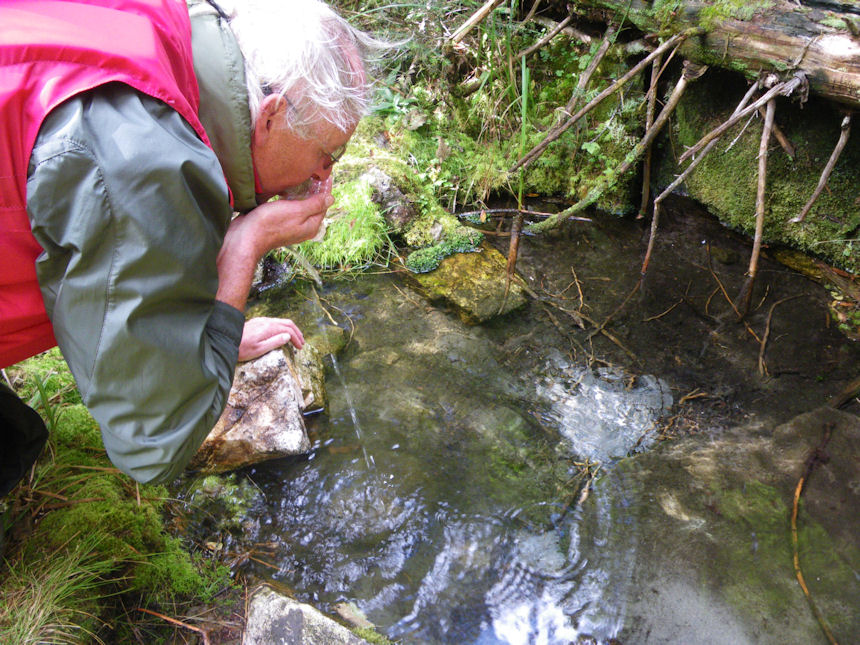
We went ashore at Tyler Point, and there we introduced ourselves to Leonard and Camille, two brothers raised in the area. Leonard suggested on our return paddle we stop at Tyler Cove for a ¼ mile hike to a natural flowing spring. The short hike was certainly worth our time, and as I scooped the delicious cold spring water into my mouth, I wondered if we had discovered the fountain of youth!

The wind was now gusting to cause us serious concern, and the waves were rolling and splashing such that I had visions of an ocean launching of our kayaks and canoes at high tide. We now needed to prove our mettle to get back to our Big Island campsite. The wind was blowing directly at us, and we needed to go perpendicular to it in order to move south along the eastern shoreline. We used whatever protection from the shore and trees we could fine to minimize our exposure to the strong winds and heavy rain now blowing across the lake from the west.

Dundee had the toughest paddle, as his aluminum canoe was like a sail in the wind. He had to paddle with his bow into the wind, at a near 90 degree angle in order to go parallel with the shoreline and not get swamped by the pounding waves. His paddling expertise and confidence were apparent as he gently moved along the shoreline.

John and I pointed our kayaks at a 45 degree angle into the western wind in order move south. We both wore kayak skirts, but some water did manage to leak into our kayaks. Our hope was we did not take too much water to avoid the need to go to shore to bail the kayaks, or worse case we would be swamped.  Bailing was nearly impossible in these winds and lake conditions, as constant paddling was needed to maintain both our direction and uprightness.

To quickly end the epic of our three hour return paddle journey, indeed we made it safely back to Big Island – a bit wet, but none-the-less without a "tip over". We had beaten the winds and white caps of Lake Umbagog.

We were drenched from the rain and water, and certainly cold, so once reaching our camp we immediately built a roaring campfire, changed into warm clothes, and boiled water for hot soup.

Never say, “I wish I had paddled Lake Umbagog”.

We would certainly return to Lake Umbagog for another paddle to explore the northern half of the Lake, including the headwaters of the Androscoggin River to the Errol Dam, and the terminus of Lake Magalloway from the Lake Umbagog Wildlife Refuge on Route 16.


  • Click slideshow to see all the pictures and videos for this trip.

  • Gift an inscribed copy of Steve’s latest book, Outdoor Enthusiast: Never say, “I wish I had…” for the upcoming holidays.  E-mail Steve at steve@outdoorsteve.com.  Give Steve the number of copies and the inscription for each book.  The price is $34 per book, and this special price includes the cost of shipping.

Certainly, we never have to say, “I wish I had paddled Lake Umbagog."