Tuesday, July 23, 2013

Never say, “I wish I had been on the Mount Sunapee Zip Line Canopy Tour”

A Visit with Family to Mount Sunapee

 My sixteen year old granddaughter, Madison, thirteen year old grandson, Carson, son Tim, and grandmother (Wife) Cathy, saw the below video of Sarah and I on the Mount Sunapee Canopy Zip Line Tour, and expressed their desire to never say, “I wish I had been on the Mt Sunapee Canopy Zip Line.”  A week later all four achieved their wish.  


What is a zip line?  Well, a zip line (also known as a zip wire, aerial runway, aerial rope slide, death slide, flying fox, or canopy tour) consists of a pulley suspended on a cable, usually made of stainless steel, mounted on an incline.  It is designed to enable a user propelled by gravity to travel from the top to the bottom of the inclined cable by holding onto, or attaching to, the freely moving pulley.  (https://en.wikipedia.org/wiki/Zip-line).

The Mount Sunapee Canopy Zip-Line Tour features a series of zip lines, rope bridges and rappelling as you descend from the top of Mt Sunapee’s South Peak. There are eight zip lines in total highlighted by the final leap on 1,000' dual zip lines which end on a platform behind the Welcome Center, from where we rappelled back down to earth. From the first tree platform to the last platform we traveled a total distance of almost ¾ mile as we flew above forest floor. Groups of no more than eight people are led by two guides as you fly through a canopy of oak, beech, maple, birch and evergreen trees. There are six ski trail crossings that offer spectacular views of the surrounding mountains and Lake Sunapee. [http://www.mountsunapee.com/mtsunapeewinter/index.asp .]

Click the Below Video and Go on Our Zip Line Tour


See Sarah and Steve on Their Zip Line Tour

My wife and I had visitors from Georgia.  Sarah, their sixteen year old daughter, heard about the Mount Sunapee Canopy Zip Line Tour.  Sarah, being a fellow outdoor enthusiast, wanted to do the Zip Line Tour – and so did I. 

Sarah and I were the only people in our group, and our tour took less than two hours.

To qualify as to who can go on the zip line tour, you must be 10 years old or older and between 80 and 260 pounds. 

We had two excellent guides, Mary and Martha.   They absolutely were part of the positive experience of doing this adventure – and they insured our safety.

Safe at All Times


  • The Clip-In With each platform, the moment we reached the platform we were clipped to the tree – not once but two times.  We could not fall off the platform if we slipped, stumbled, or were pushed.  As Sarah and I took turns jumping first, we remained clipped to the tree until we were positioned, and one by one – a clip was release and then re-clipped to the zip line.  Thus, again, in case we jumped or slipped before being ready or instructed, we still would not fall from the platform.

  • Before each jump, we received instruction pertinent to the particular zip line, bridge, or belay we were about to do. [Belaying refers to a variety of techniques climbers use to exert on a climbing rope so that a falling climber does not fall very far.  A climbing partner typically applies friction at the other end of the rope whenever the climber is not moving, and removing the friction from the rope whenever the climber needs more rope to continue climbing.  The term "belay" also means the place where the belayer is anchored; this is typically a ledge, but may be a hanging belay, where the belayer is suspended from protection in the rock, or in our case the wooden platform [http://en.wikipedia.org/wiki/Belaying ].
  • Before each of the eight leaps, Mary or Martha would explain what to do, and then the guide would go first with her leap – this served both to demonstrate and to have the guide at the end of the zip line.

  • The guide at the beginning of the zip line would wait for the guide at the other end to yell “Clear”, and then confirm it with a “clear” – and then I/Sarah would jump.
The First Leap
We rode the Sunapee Ski lift to South Peak to our first platform.   We then climbed about fifteen feet on a rope ladder up the hillside platform.  Now came the moment I was there for – the zip line leap.

I must confess my stomach was tight for this first jump – and I was sweating with nervousness and anxious anticipation.  I looked downhill at the next platform hundreds of feet away, and thought, “What am I doing here?” I had all kinds of reservations as to whether I “really really” wanted to jump from this height.  Would the harness hold me?  Was I strong enough to hold on to the harness strap (no worry here as the harness cable strap was simply to give me “confidence.”)

My first jump was here.  I was all clicked to the cable, and Maratha said, “OK Steve, you can jump.”  I looked at Martha to be doubly positive I heard her correctly, and asked, “Is it OK to jump?”  [It never hurts to be absolutely certainly about this.]
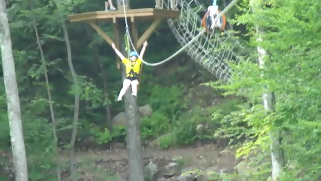

You have to believe in the equipment and in your guides!!   The adrenaline rush came and the commitment was there.  I Leaped!!!  The harness held and I was flying down the cable with an eagle’s view of Mount Sunapee and Lake Sunapee.  It was a thrill!!

The Leap of Trust
With each zip line jump I gained confidence in myself.  As I readied for the fourth zip line leap, Mary asked, “Do you want to try the “Leap of Trust?”  I questioned her, and she said, “You jump off backwards without holding on to the harness strap.  Watch me.”  She took a short run off the platform and jump backwards into the open sky!  You will need to watch the below video to see if I made it. 


How to Dress
The Zip Line tour operates rain or shine, so you must dress appropriately. They recommend hiking boots or sneakers, and no open-toed shoes, sandals, or other footwear that can fall off. Sarah and I both wore sneakers - and this was perfect for us in warm summer weather.

In the summer it is suggested that participants wear shorts that  fall mid-thigh or lower and either short or long sleeves. No tank tops are allowed as the harness straps may cause discomfort. They provided all needed safety equipment including a helmet and zip line harness. You may also want to bring sunscreen, bug repellent, a small pack or fanny pack for cameras, snacks, etc.

You need to watch the below video to see Sarah and my first leap, our “Leap of Trust”, rope bridge crossing and belaying.


To see the web site for the Mount Sunapee Canopy Tour go to http://www.mountsunapee.com/mtsunapeewinter/adventurepark/welcome.asp


To see more detail on our Mount Sunapee Canopy Zip Line Tour I have prepared an 11 minute video.  Click Here to see the unedited thrills of the Zip Line.

Winter Wild Race at Mount Sunapee, Newbury, New Hampshire

Mount Sunapee is an outdoor enthusiast’s four season paradise.  The Zip Line Canopy Tour was not my first time on the mountain.  I have hiked and alpine and telemarked skied here, and done many triathlons from this glorious and beautiful area.

A special winter experience at Mount Sunapee is called a Winter Wild Race that is a cold weather race on snow around the perimeter of Sunapee’s ski area.

Winter in New Hampshire offers unique and exciting opportunities for outdoor enthusiasts. In one of my blog posts I share my training and research in preparation for running a race up the ski slopes of Mt Sunapee in temperatures around ten degrees.

The race is usually held in early March (http://www.winterwild.com/) at Mt Sunapee, Newbury, NH (http://www.mountsunapee.com/).


Go to http://outdooradventurers.blogspot.com/2011_02_01archive.html to see my Outdoor Enthusiast blog for this unique winter race.


For other outdoor adventures with Outdoor Steve go to http://www.outdoorsteve.com and click the BLOG link.

Outdoor Play "Fun 4 4 Seasons"

Steve's latest book, Outdoor Play "Fun 4 4 Seasons" is now available in paperback and e-book at OutdoorSteve.com and Amazon.com. Outdoor Play has more adventures at Mount Sunapee and Places to Play in Northern New England.

Thursday, June 20, 2013

Paddling the Northern Forest Canoe Trail: The Clyde River - Island Pond to Pensioner Pond


Paddling the Northern Forest Canoe Trail (NFCT)
The Clyde River - Island Pond to Pensioner Pond
Vermont

Three friends and I spent four days paddling the Clyde and Nulhegan Rivers, and Spectacle Pond – parts of what the NFCT calls section 6.  Island Pond is the highest point in the NFCT, and serves as the headwaters for the Clyde River, which flows 40 miles northwest to Lake Memphremagog and leads to the Saint Lawrence River.  Island Pond, through Spectacle Pond, is also the headwaters for the Nulhegan River, which flows east to the Connecticut River.

This blog and video will focus on the Clyde River.


We tented at Brighton State Park at Spectacle Pond shoreline for four days.


Water Conditions
  • On Day One the Clyde River water was clear and moving slowly from our Island Pond put-in to Ten Mile Square Road take-out. Paddling from Island Pond to Five Mile Square Road was five miles of zigzagging and took us about four hours. We overcame at many obstacles such as down trees in the river, beaver dams, Class I-II boulder fields from a washed out logging-era dam, and walls of wood debris and blow-downs.  The water level exposed many of the felled trees and was a challenge to our kayak and canoeing skills to overcome these barriers without portaging. The width of the river from Island Pond to Ten Mile Square Road was narrow (ten to twenty feet wide).
  • Day Two was an all-day drenching soaking rainstorm, and we only managed a brief evening paddle on beautiful Spectacle Pond passing the NFCT sign to portage to the Nulhegan River.
  • On Day Three we continued from our Ten Mile Square Road take-out nine miles to Pensioner Pond. Certainly the previous days deluge had an impact on the Clyde’s width and speed with overflows with high water levels.  We estimated a 3 to 4 mph current that really moved.  This Day Three section had more marsh and fewer trees than Day One from Island Pond to Ten Mile Square.
Questions on how we found conditions on the Clyde?

We used the highly recommended NFCT online Trip Planner (http://www.northernforestcanoetrail.org/tripplanner/) to plan and map our trip.  We also purchased the NFCT Lake Memphremagog to Connecticut River Section 6 water protected map - and referred to it frequently throughout our paddle.

How long does it take to paddle from Island Pond to Five Mile Square Road, and then to Ten Mile Square Road?  How long does it take to paddle from Ten Mile Square Road to Pensioner Pond?  The Island Pond to Upper Clyde reference (http://www.northernforestcanoetrail.org/media/Island_Pond_And_The_Upper_Clyde.pdfhas a very good Trip Summary of paddling miles and times.

Want to know what it feels like to paddle the Clyde River?  What does the country side look like? What obstacles may be encountered?  Want to see Tim, John and Dundee paddle a short section of Class I – II boulder field rapids?

Before you watch the below video let me get you psyched for watching my friends go through the rapids.

Normally, as we approach log dams and other obstacles in the river, we slow and check the area for our approach, and then go through one person at a time, waiting to make sure each person safely gets through before the next person goes.  When we know rapids are ahead, we stop before the rapids and scout the best way to go through the rapids.

 About four miles from our put-in at Island Pond, I was the first person through one of the many fallen trees blocking the river, and my intent was to paddle clear of this obstacle and wait for my fellow paddlers.  However the fallen tree was on a bend, and when I made it through the barrier on the bend I immediately found myself to what looked like Class II white water without a place to pull out and wait for the next paddler.

Essentially I was committed to these rapids with boulders and small drops, not really knowing how rough they were nor how long they would last.  I was safely able to make it through this two hundred yard set of rapids – and as you will see next, my friends did like-wise.  Enjoy his short movie clip made when I ran back on the river bank, too late to warn my friends of their upcoming surprise.

Clicking the below video provides my excitement filming my friends negotiating rapids. 


So what is the Northern Forest Canoe Trail (NFCT)?
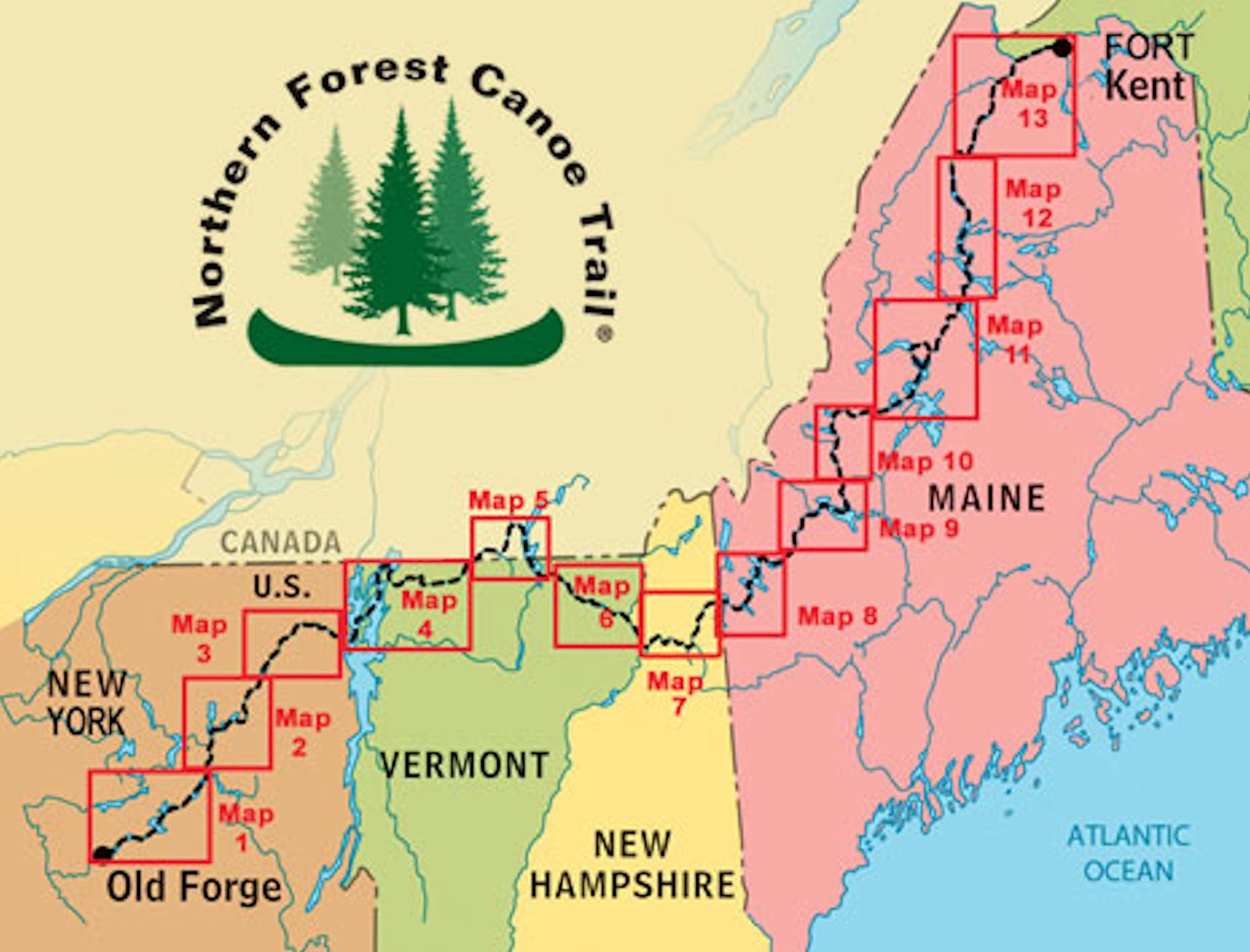
The NFCT is a living reminder of when rivers were both highways and routes of communications; the Trail is a celebration of the Northern Forest.  The Trail is 740 miles of historic waterway traveled by Native Americans.  It begins/ends in Fort Kent Maine, and travels through Maine, New Hampshire, Vermont, Quebec, and ending/beginning in Old Forge, New York.  http://www.northernforestcanoetrail.org.

The NFCT is a journey through the landscape of the northeast.  The land speaks of its history – of rocks and ruins, people and plants, and natural and economic forces at play.
The sections of the NFCT that friends and I have paddled are:
  • The Allagash Wilderness Waterway
  • Lake Umbagog; Androscoggin River
  • Lake Memphremagog
  • Connecticut River
  • Moose River and Attean Pond on the historic “Moose River Bow Trip”
  • Umbazooksus Stream
  • Clyde River, Nulhegan River, and Spectacle Pond
See my NFCT travels in my recent book, Outdoor Play Fun 4 4 Seasons (http://www.outdoorsteve.com) and my blog, (http://outdooradventurers.blogspot.com/)  
Special 24 Minute Clyde River Video: Clicking here provides the Northern Forest Canoe Trail ordeal of a writer/cameraman who is also occupied as a kayaker on the Clyde River in the Northeast Kingdom of Vermont. 

"Everyone must believe in something. I believe I'll go outdoors." – S. Priest
------------------------------

Steve’s latest book, Outdoor Play "Fun 4 4 Seasons" is available as an e-Book at Kindle and hard copy at Amazon.com.


References

Friday, April 26, 2013

**New - Outdoor Play ”Fun 4 4 Seasons” **


My latest book, Outdoor Play “Fun 4 4 Seasons”, is now available.   I use a four seasons of the year format to discover unique ways and resources to enjoy the outdoors.

Outdoor Play “Fun 4 4 Seasons” enthusiastically portrays a daily commitment to the outdoors for health and fitness. 
 
The book is full of short story adventures that give the reader an overview of multiple outdoor things to do.  My message is to get outdoors and do something.  The only competition you have is the task at hand.  Do not worry about reaching the top of the mountain - just concern yourself with staying on the path.

Outdoor Play “Fun 4  4 Seasons” starts with a process – How to be an Outdoor Enthusiast.  The middle chapters are the seasons of the year, Spring, Summer, Fall and Winter from my blog – Outdoor Enthusiast.


The Places to Play Northern New England chapter tells where to discover outdoor treasures.  New Hampshire, Maine, and Vermont are emphasized for their unique outdoor offerings. The Northern Forest Canoe Trail, Great North Woods, Maine Island Trail, and the Appalachian Trail have references galore.

Chapters Outdoors as a Component of Daily Life and Eclectic Sharing provide unique tips and readings.  Campsite tips to cook an egg in an onion, canoeing and kayaking on exceptional waters, smart phone apps, giant pumpkin regattas, winter sleigh rides, triathlon clubs, sea kayaking, island camping, indoor bicycle training, axe throwing, and advice on preparing for the outdoors are amongst diverse stories shared.  Videos and action pictures proclaim the physical fitness and mental health impact of the outdoors.

The last chapter, The Beginning, is my personal story of how I went from a debilitating injury to a daily outdoor enthusiast.

The book relates how, where, and ways to make outdoor activity a “lifestyle for the long haul” regardless of age, limited time, family commitments, or knowledge of an activity. Order Outdoor Play "Fun 4 4 Seasons" at http://www.OutdoorSteve.com

“Everyone must believe in something.  I believe I will go outdoors with my family.” S. Priest
--------------------------------
Available in 1) Paperback black and white, 2) E-book, and 3) Special Addition Full color. 323 pages, 250+ pictures, 6 ” x 9 “.  Order at http://www.outdoorsteve.com

Wednesday, February 27, 2013

Places to Play in Northern New England


I thought I would share a peek into my book, Outdoor Play “Fun 4 4 Seasons”. 

The first section, How to be an Outdoor Enthusiast, is for beginners and those who hesitate because of age, limited time, family commitments, or seek “How to” for an activity.  It describes the process of being an outdoor enthusiast.  The middle sections are divided into the year's seasons, Spring, Summer, Fall, and Winter, with glimpses of my outdoor treks taken from this Outdoor Enthusiast blog. 

The following section, Places to Play in Northern New England, provides web references to local activities and clubs as incentives to learn and participate in the outdoors.

Two sections, The Outdoors as a Daily Component of Life, and Eclectic  Sharing, deal with outdoor book reviews and tips such as smartphone Apps for the Outdoors and Cooking an Egg in an Onion Over an Open Campfire.

The last section, The Beginning, is my personal story of becoming a committed daily outdoor enthusiast.

Below is a look into the section titled, Places to Play in Northern New England.   The Appalachian Trail, Androscoggin River,  Great North WoodsNorthern Forest Canoe Trailand Maine Island Trail will be highlighted.

------------

Inter-State Opportunities for Outdoor Play

Northern New England has some scenic, relaxing, simply exciting inter-state outdoor opportunities for all seasons.  Certainly waterways, forest trails and mountains have no sense of state boundaries.  Here are five non-profit organizations offering unique places to play in northern New England.

Androscoggin River

The Androscoggin River is a major river in northern New England. The Androscoggin begins in Errol, New Hampshire, where the Magalloway River joins the outlet of Umbagog Lake.  It is 178 miles long and joins the Kennebec River at Merrymeeting Bay in Maine before its water empties into the Gulf of Maine on the Atlantic Ocean. Its drainage basin is 3,530 square miles (9,100 km2) in area.


The Androscoggin River Watershed Council offers protection, history and paddling of the Androscoggin River.  The ARWC sponsors Source to the Sea.  Outdoor Steve has paddled twelve sections of this Trek and you can find descriptions of this fabulous paddle in Steve's Outdoor Play books.

Interestingly, 19 miles of the Androscoggin River headwaters are also part of the Northern Forest Canoe Trail (NFCT)!


Great North Woods

Northern New Hampshire, also known as the Great North Woods Region, is the official state tourist region located in Coos County. This area includes Northern New Hampshire, bordering Northeast Kingdom Vermont, and unincorporated townships in the northern and northwestern part of Maine.

The Northern Forest Canoe Trail

The Northern Forest Canoe Trail (NFCT) links the waterways of New York, Vermont, Québec, New Hampshire and Maine.

 
The NFCT is a long-distance paddling trail connecting the major watersheds across the Adirondacks and Northern New England. The Trail links communities and wild places offering canoeists and kayakers a lifetime of paddling destinations within the 740-mile traverse across New York, Vermont, Quebec, New Hampshire, and Maine.  The NFCT includes flat and whitewater paddling, poling, lining, and portaging (62 portages totaling 55 miles).

A visit to the NFCT can be a day-trip, an overnight, weeks, or months. As hikers do sections of the Appalachian Trail, so do paddlers do the NFCT.  You can put-in and take-out at any appropriate location.  The NFCT organization is a great resource for your trip plan, web links, and contacts.
 
Scheduled regional presentations by NFCT staff can be viewed on the NFCT web site.  See the Planning link at the site for guidebooksand maps.

Three of my NFCT blog posts are below:

Appalachian Trail

The AT in northern New England passes through Vermont, New Hampshire with its northern terminus at the peak of Mt Katahdin, Maine.
  
I recommend two references to get started with the AT:


The Appalachian Trail Conservancy preserves and manages the Appalachian Trail – ensuring that its vast natural beauty and priceless cultural heritage can be shared and enjoyed today, tomorrow, and for centuries to come.

 The Appalachian Mountain Club (AMC) promotes the protection, enjoyment, and understanding of the mountains, forests, waters, and trails of the Appalachian region.

The AMC staff offers outdoor experiences and programs focused on their Maine and New Hampshire huts and lodges.  Four of my Blog posts on the AT:

The Maine Island Trail

The Maine Island Trail begins at Maine's border with New Hampshire and ends in Machias, Maine, with an additional collection of two islands in the Passamaquoddy/New Brunswick region of Canada.
  
The Maine Island Trail is a 375-mile-long waterway along the coast of Maine that connects approximately 200 islands and mainland sites available for day visits or overnight camping.  The trail is operated by the Maine Island Trail Association(MITA). Through partnerships with the State of Maine, as well as land trusts, non-profit organizations, and generous private property owners, MITA ensures access to these sites for visitors in kayaks, sailboats, motorboats, and other watercraft. In exchange for access, MITA members agree to visitation guidelines set by the island owners and provide a wide range of stewardship services including island monitoring and management by trained volunteers and 10 organized regional island cleanups each year.

This is the Maine Island Trail Association’s 25th Season, so they have a lot of fun activities in store to celebrate that, including a photo contest.  MITA wants to get photos from all 200 sites that they will geo-coded on the web for all to view.  Send your photos!
 
FAQ on MIT Site Reservations

The only sites (public or private) on the Maine Island Trail that take reservations are Warren Island, Swan Island (Kennebec), Cobscook Bay State Park, and Butter and Burnt Islands.  All others are first-come first-served (FCFS). Details are in the member Trail Guide.  The MITA advises people to have a backup in mind and arrive with time to spare.  However, the fact is that except for peak weekends on smaller most favored islands, people typically do not report difficulties.  There are a lot of islands to go around!

See Outdoor Steve’s Blog post on his Maine Island Trail trek:

"Everyone must believe in something. I believe I'll go outdoors." – S. Priest
--------------------------------------------------

Steve’s books are available as hardcopy and e-Books at Amazon's Kindle and hardcopy at Harborside Trading Company, 81 Main St, Sunapee, NHWild Goose Country Store, 77 Main St, Sunapee, NHMorgan Hill Bookstore, New London, NH, Bookstore at Colby-Sawyer College, New London, NH, Dartmouth-Hitchcock Gift Shop, Lebanon, NH, and Village Sports, New London, NH.


  Outdoor Play has trip preparations, routes, and narratives of bucket list places to go. The book will motivate friends and family to make the outdoors a key component of their daily life. 


Additional Sources of Books at:
Hardcopy at: http://outdoorsteve.com and https://www.amazon.com/dp/098503842X
E-book at: https://www.amazon.com/dp/098503842X